Beyond identity
Exploring What Remains When the Uniform Comes Off

What happens to military identity when the uniform is no longer there?
For a little while now I have been painting portraits of veterans exploring whether military identity remains when the uniform is removed. The project is going well and as I embark on my 5th project I wanted to look back at it and review whether is hitting the spot.
As the project has progressed I have realized that the idea is more complicated than simply removing the uniform.
I am becoming increasingly interested in what remains.
Identity without the uniform
One of the strongest elements of the project so far has been the way the paintings have begun to reveal the identities of my sitters through their relationships, environments, gestures and personal details.
Michael's portrait, for example, is a painting of him with his daughter. There is no obvious military symbolism. Instead, the relationship between father and daughter becomes central to the painting. His tattoos provide another small insight into his life, but the painting isn't trying to announce that he is a veteran.
Similarly, Annette's portrait uses her working environment, architecture, safety glasses, PPE and expression to communicate something about who she is now. Her identity is rooted in her present life and her work within the construction industry.
Interestingly, feedback on this portrait suggests that her expression communicated something beyond the obvious visual information. It has been observed that while Annette appeared confident in her knowledge and skills, there was also something less confident in her expression—as though she had to work hard to be heard within her working environment.

That was particularly interesting to me because it was something Annette herself had described when we talked about her experiences.
For me, this was an important moment. It suggested that the painting wasn't simply describing what Annette looks like; it was beginning to communicate something about how she experiences the world.
And that is where the project becomes more interesting.
Making the transition visible—but not obvious
I still need to develop the idea of transition.
The paintings are successfully showing civilian identities, but I don't think all of them yet communicate the journey between military and civilian life.
I don't want to solve this by simply putting obvious military objects into the background. Instead, I'm interested in finding subtle connections between past and present.
These might be found in a gesture, a posture, an object, a landscape, a relationship or something within the environment.
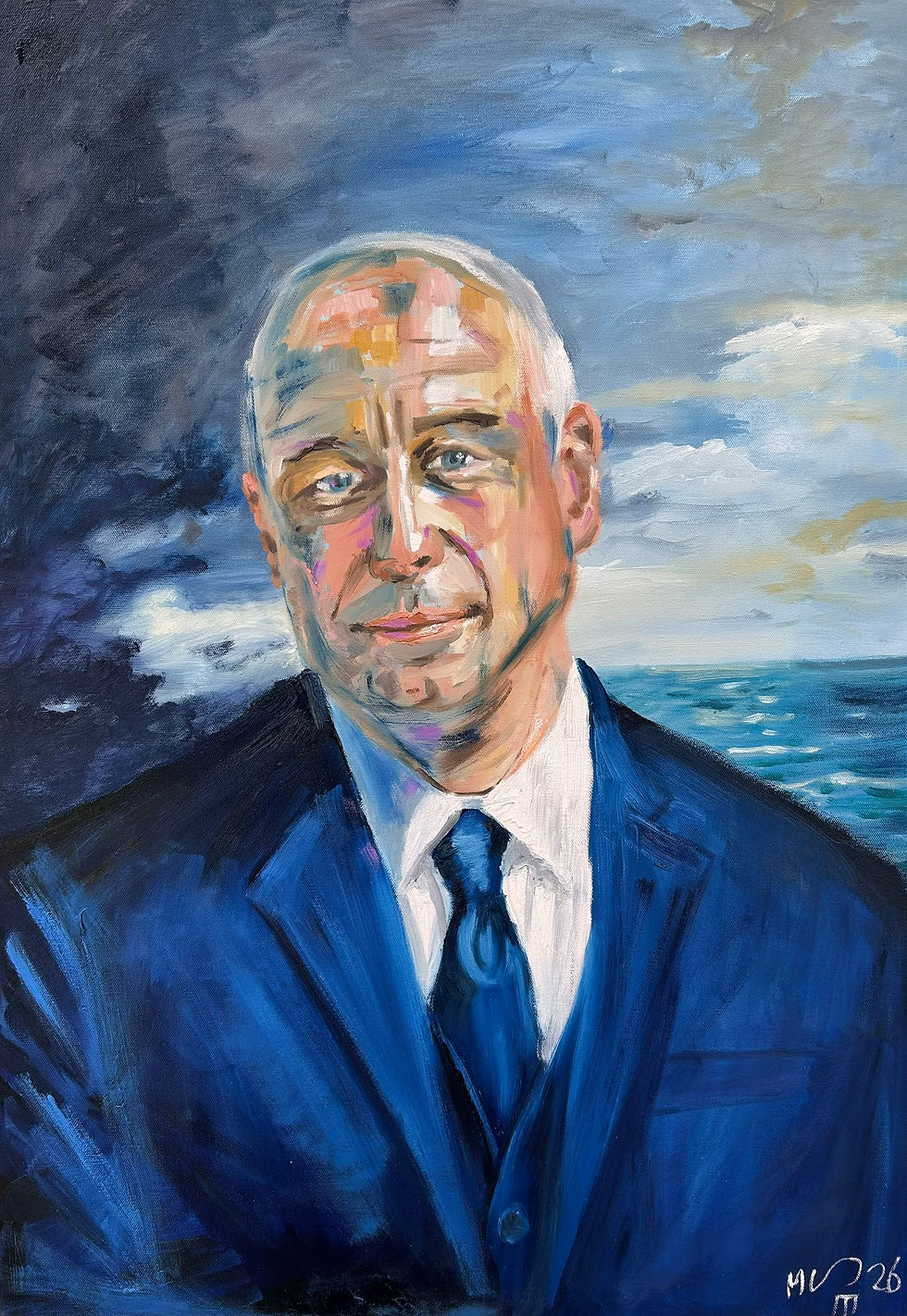
In Joe's portrait, for example, the sea provides a connection to his past. It is not an obvious military reference, but it provides another layer of meaning.
This is something I am now thinking about as I develop my next portrait. Can I introduce a subtle connection between his past and present without explaining it to the viewer? I think I have achieved this more successfully in the portrait of Babatunde.
Ideally, I want the viewer to discover these connections for themselves.
That subtlety is important because another central idea of the project is visibility.
When the uniform disappears, so does much of the immediately recognisable visual identity of the veteran.
I want to create paintings where, initially, the viewer may have no idea that the person they are looking at has a military background.
The revelation can come later.
Perhaps the exhibition label tells them.
Perhaps a small visual clue makes them reconsider what they have seen.
That moment of realisation is part of what interests me.
Identity as layers
This idea also connects to the way I paint.
I am not trying to create neutral, photographic representations of my sitters. My brushwork remains visible and expressive, and I use colour emotionally rather than simply trying to reproduce the colours I see.
Joe's face, for example, is constructed from layers of oranges, pinks and ochres alongside blues and greys. I am not simply matching a skin tone.
This approach has been influenced by artists I have researched, including Lucian Freud and Tim Benson, but it also supports the conceptual thinking behind the project.
If identity is something constructed from different experiences, relationships, memories and environments, perhaps the painting should feel constructed in the same way.
The sitter is not a fixed photographic image.
They are made up of layers.
The sitter becomes part of the process
Another important development has been the relationship I have built with the people I am painting.
The sitters are not simply providing me with a photograph and then disappearing from the process. Conversations with them have influenced compositions and helped me understand how they see themselves and how their experiences have shaped them.
I've gone through several ideas with Annette, for example, and I'm currently doing the same with Daz.
Ultimately, I make the decisions about the painting, but those conversations have become an important part of the process.
They have made the work more fluid.
They have also reminded me that I am painting someone's identity as they understand it themselves, rather than simply imposing my own interpretation onto them.
Research and painting feeding each other
One of the things I have found particularly interesting is that my research and my practical work no longer feel like separate activities.
They feed into each other.

My research into portraiture and military identity influenced the decision to focus on veterans and reservists in their current lives. But then the act of painting creates new questions that send me back into research.
For example:
How much of someone's military identity needs to be visible for us to recognise it?
Can a viewer understand something about someone's service without seeing a uniform or medals?
Where does military identity sit once someone has moved into another part of their life?
These questions don't necessarily have straightforward answers.
Each portrait creates a slightly different problem.
Research influences the painting, the painting creates a new question, and that question sends me back to research.
The paintings themselves have therefore become a form of research.
They aren't simply the final outcome of my investigation. They are helping me investigate the subject.
Research → painting → reflection → new question → further research → new painting
Going beyond simply illustrating the idea
Perhaps the biggest change in my thinking has been recognising that painting veterans without uniforms is not really the objective of the project.
It is the method.
The bigger question is:
How does military identity persist after service? Does it change, disappear or become part of a new civilian identity?
Portraiture gives me a way of exploring that question through both the visible and invisible traces of someone's past.
This has also changed the way I judge each painting.
Rather than simply asking whether I have made a successful portrait, I am trying to ask:
What does this painting tell me about this person's identity, their life and their service?
And perhaps more importantly:
Does it tell me something that the previous painting didn't?
If the answer is no, then perhaps I haven't pushed the idea far enough.
That is where I want Beyond Identity to go as I move towards the completion of the project.
I don't simply want to present a series of portraits of veterans.
I want the paintings to ask questions.
I want the viewer to look at someone who appears to be an ordinary person in an ordinary part of their life and then discover that there is another story underneath.
Because perhaps that is what identity really is.
Not one thing.
But layers of experience, relationships, memories and choices that remain with us long after the uniform has been taken off.


Comments